Wednesday, April 12, 2006

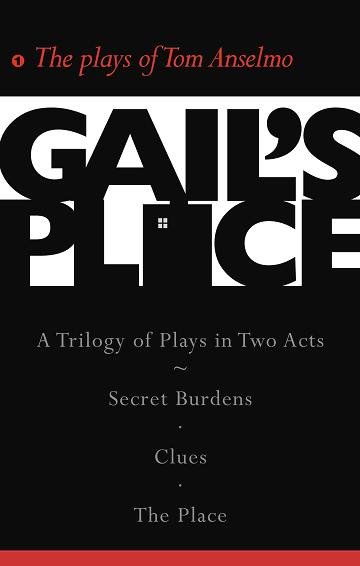
Gail’s Place: A Trilogy of Plays in Two Acts


Thomas Hardy didactically preserved his Tess, a young woman who attempted to be honest in her intimate relationship by revealing her secret, and thus ended at the gallows. Tom Anselmo takes care to let his Gail clinch a footing in both her inner and social worlds as she unveils the mask of falsity in relationships. Anselmo’s first volume of plays is a trilogy of two-act plays by the title Gail’s Place (Red Brindle Press, New York, 2006). While each plays stands on its own plot, central to all is Gail Stanza’s character, a woman who is bent on reconciling her inner self with that of her social role by cracking secrets that tend to stifle one’s individuality and true identity.

The opening play Secret Burdens centers Gail Stanza at the heart of their party in the honor of their friends’ marriage anniversary. While Lily attributes her marriage’s success to care in keeping secrets from the spouse, as do Mark and Evelyn, Gail is disposed nearly in excess to resurrect past grievances so as to ensure calm in the future. Gail’s character has no hint of sullenness about her and so the audience is likely to appreciate her assertiveness as the moral implications of it unfold.

Clues starts as a detective drama with Evelyn Harper lying in coma in the hospital. Gail’s speculations about Mark are turning into reality and the question of responsibility arises from the depth of Gail’s character. We meet Gail’s inner self, personified, and conversing with Gail over shutting down of vital human sensibilities. Gail’s self-conscious speech makes her a lovable character: ‘I have the distinguished honor of being a big-mouth.’ And her pride in her truthfulness is an impetus to secretive sufferers like Margaret: ‘I’m glad I don’t have the kind of ties that turn us into moral pretzels.’ As Gail scatters the shards of hypocrisy for good, Lily sees her own inner self, clad in a shroud, rising and walking. Anselmo’s genius shows, not tells, how to connect with your being’s center.

The third play The Place moves the argument closer into Gail’s home as her husband Ron finds himself at odds with his inner self against his colleague’s promotion grounded on Ron’s support. Carl is suspected of sexual harassment of one of his students. Again it is Gail who goads her husband to act in harmony with his inner voice. Gail’s personified, abstract, self finds a mate in form of Ron’s resurrected center. Alongside we see the false consciousness of Lynn, Carl’s wife, who accepts compromise as matter of course.

Anselmo has fixed the familiar signboard of serious drama in the history of modern literature. With no foul language, no hip-hop mania, conscientious protagonists, and character-driven situations, Anselmo’s plays speak the truth about the nature of secrets, their implications, and behavioral significance.

The serious subject matter and ease of writing style place Anselmo’s book among lovable reads.

ISBN: 0977079414

Availability

http://www.amazon.com/gp/product/0977079414/qid=1144838070/sr=1-1/ref=sr_1_1/103-9724660-3863057?s=books&v=glance&n=283155

Author Website: http://www.tomanselmo.com/index.html

Saturday, April 08, 2006

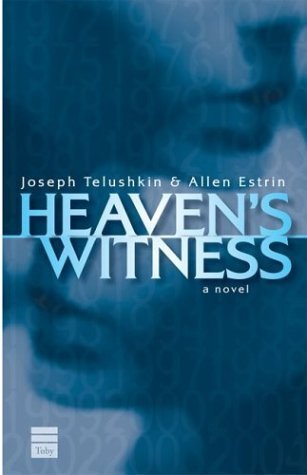
Heaven’s Witness


In the vista are two authors, Joseph Telushkin and Allen Estrin, who have joined heads to chill the breath of mystery nuts with their paranormal psychological thriller Heaven’s Witness (Toby Press, Connecticut, USA, 2004). The prologue of this 462 pages, hardbound, chiller sets one’s curiosity on heels in a second and keeps the reader’s breath stranded for a pretty good while.

To call Heaven’s’ Witness a unique thriller of its kind would be overlooking an overwhelming number of thriller books and movies. Those Indian flick maniacs are long familiar with the ‘transmigration of soul’ belief and even in Hollywood it is not a novel idea. Heaven’s Witnes's specialty is the way it has attempted to reconcile the age-old idea of soul survival with the partially explored realm of paranormal psychology.

In the novel, we meet Robin Norris, a young actress of twenty-five, who is taken in deep hypnotic trance by a psychiatrist Jordan Geller. In a state of regression, Robin assumes the identity of a seventeen-year old girl Beverly Casper and describes a horrifying murder scene of the teenager, a murder that took place seven years prior to Robin’s birth. Who can resist leaping up! The story thus proceeds in the usual suspense movie style with a series of murders of teenage girls, each killing followed by a message to the parents from the Messenger, the serial killer. Suspects get shifting in the reader’s mind and the protagonists run themselves in deeper trouble before finally coming up with the Messenger’s real identity.

Two things undermine the novel’s take over. First, the question killer who? is answered nearly in full by the time we read a little more than half of the book. Second, the curiosity about why is quenched at nearly the same time. What is worse is that the main hook in the story Is Robin’s account an instance of reincarnation or a rationally possible revival of suppressed memory? is left unresolved at the end. The effect is like being cheated.

There are weaknesses that are all too obtrusive. Dr. Geller’s hypnotic skills working on Robin are almost cartoonish. Lack of character development is the book’s Achilles Heel. The element of romance in the story is little more than dead and we look at a passive, talking-only hero. The situations are not effectively experienced from any single character’s eyes and a feeling of detachment from the whole tale prevails through most of the book’s’ length. Perhaps it is what comes off when you try to gather thirty-two years of mystery in two weeks of the narration’s span.

In spite of all the weaknesses, Heaven’s Witness has some convincingly appreciable qualities. Deviant psychiatrist Geoffrey Bolton’s belief things just don’t happen, there’s a reason is a conviction that strengthens Dr. Geller’s case of pursuing his view of reality with genuine force. The need to deviate from the stereotyped and clichéd has found firm footing in the story’s framework. Still more significant is the psychological peep into the depths of some common diseased products of life: the panic-stricken writer whose real disease is the degradation of audience’s taste of comedy, the porn-obsessed young man whose root problem is low self-esteem on account of his homely figure, and the mother-hating young woman who is the victim of her domineering mother’s hard-shelled feminism.

Heaven’s Witness is a nice read but not hypnotically riveting.


ISBN: 1592640915
Availability

http://search.barnesandnoble.com/booksearch/isbnInquiry.asp?isbn=1592640915

http://www.amazon.com/exec/obidos/ASIN/1592640915/ref=ase_thetobypress-20/103-2282091-6541424

Saturday, April 01, 2006

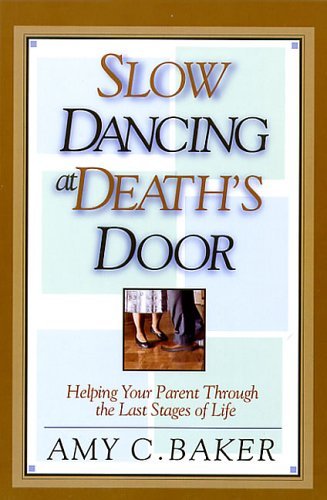
Slow Dancing at Death’s Door: Helping Your Parent Through the Last Stages of Life


It is impressive to see that a woman, Amy C. Baker, from the corporate world has stepped forward to show us our deepest human value: the need for serving our departing generation. Her book Slow Dancing at Death’s Door (Life Journey/Cook International, Colorado, 2006) incarnates a healthy form of what has been called ‘Survivor’s Syndrome’. Amy Baker exhausts her experience of anger, frustration, loneliness, and grief, that are the lot of so many aging members of our ‘Sandwich Generation’, and comes out with an enlightening lesson: forgiving for not knowing better.

Losing her mother to cancer and father to Hepatitis C, Amy Baker recounts what it feels like losing your loved ones and how best you can play your role of a caring child, at the same time a spouse, a parent, a responsible employee, and many temporary roles that one is obliged to take in life. That business world has not calcified her human spirit shows in Baker’s account of all she did for her dying parents to claim her success as a humane being. That she is an intelligent writer is evident from the warmth and energy of emotion that saturate her expression throughout the book.

As Amy Baker maturely embellishes her passages with good-hearted humor, the gravity of a subject like death (and that of one’s own parents) has no chance to oppress or offend the reader. However, Baker does more than that. With her faith, she illustrates the falsity of our perfection-seeking attitude towards life, thus showing us the importance to shed our slough of self-centeredness while at the same time not overlooking the need to take care of ourselves in order to be able to care for our parents. The emphasis is on growth not only in flesh and blood but more so in human spirit. On the practical side, we can see advice on hospice, management of ailing parents, and legal matters pertaining to inheritance, estate panning, and wills.

The nonconformist reader might frown over Baker’s frequent resort to biblical quotes, which are seen as the source of inspiration and divine power. This does become a bit obtrusive, especially at end of the book, where the author discusses preserving family history for future generations. Nevertheless, the spontaneity of her account of her parents’ death holds high her attempt to ‘light beacons of hope’ in her reader’s heart. The touching beauty of Amy Baker’s tapestry of words in paying homage to her late parents is heart winning. She is one writer who emerges victorious from her situation as a caring survivor.

ISBN: 0781442621

Availability

http://www.amazon.com/gp/product/0781442621/002-0762099-9752030?v=glance&n=283155

http://www.powells.com/biblio?show=TRADE%20PAPER:NEW:0781442621:13.99#synopses_and_reviews

http://www.allbookstores.com/book/0781442621/Slow_Dancing_At_Death

Author’s Website http://www.amycbaker.com/

Sunday, March 26, 2006

Dressed in Fiction


Starting with a discussion of the centrality of fashion in dress to human behavior, independent scholar Clair Hughes takes a look at the employment of dress in select English fiction in her book Dressed in Fiction (Berg Publishers, Oxford-New York, 2006). Clair’s work is a confluence of literary criticism and critical description of scenes of dress in a group of English fictional texts written over a period of about 200 years, from early eighteenth to the late twentieth century.

As the author admits beforehand, most of her discussion in the book is of fashionable, middle or upper class clothes; the reason being that dress of the underclass varies little until the advent of the mass market. The novels chosen for the bulk of the discussion range from Daniel Defoe’s Roxana to Edith Wharton’s The House of Mirth, and the author sums up the topic in a quick glance at fiction from Samuel Richardson’s Pamela to Anita Brookner’s Hotel Du Lac.

While Clair Hughes makes women’s dress the core of her consideration, she does not fail to relate the ideas of gender, color of the dress, technical terms for costumes, and the excess or absence of dress references. Thus an interest in history and society is at once sated through the medium of clothing. Literary criticism shows in the author’s ingenious foray of the exploration of how fiction authors’ employment of dress and its accessories can illuminate the structure of that text. Ultimately, human values of the specific social world that existed at the time of the text’s creation are researched.

Supplementing the book’s discussion are paintings or engravings of nearly the same date as the text in view, imparting a general image of the period and its particular style of dress. This is a merit of the book that counts.

Dressed in Fiction has its shortcomings. Devoting an appreciable amount of space to history and stories of the fictional works, it fails at places to relate strongly the employment of dress with the main frame of the novel’s plot. An intrinsic connection of situations taken up for explanation with the dress described does not always seem valid.

Endnotes, a bibliography, and an index at the end of the book give an academically professional touch to it.

In its entirety, Dressed in Fiction is an experimental work following the lines of Gillian Beer’s 1989 book Arguing with the Past. It opens up a topic for critical discussion to be fathomed by future studies.

ISBN: 1845201728

Availability

http://www.amazon.com/gp/product/1845201728/sr=8-1/qid=1143386870/ref=pd_bbs_1/103-9167745-6114234?%5Fencoding=UTF8

http://www.walmart.com/catalog/product.do?product_id=4229839

http://www.booksamillion.com/ncom/books?pid=1845201728

Wednesday, March 15, 2006

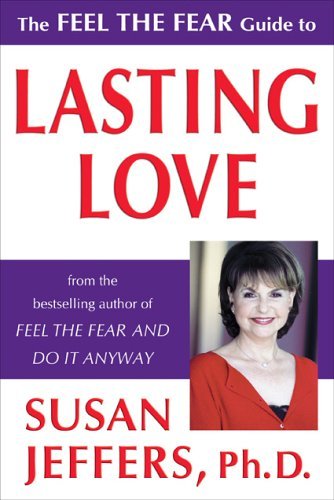
The Feel the Fear Guide to Lasting Love


The subject of a successful love relationship has been tried to banality in innumerable publications. While most of them might be out in the print for making bucks, Susan Jeffers’ latest book The Feel the Fear Guide to Lasting Love (Jeffers Press, California, 2005) is one winning endeavor of showing the path to a lasting love life. Jeffers, who has been titled with ‘the Queen of Self-Help’, presents secret lessons of love that make one’s person lovable rather than tiring oneself out in finding an ideal mate. It teaches how to be the ideal mate.

The conversational style of Susan Jeffers befriends the reader since the first page. Her openness inspires when she confesses that her meaningful knowledge of love did not come from her university degrees but from her personal experience of marriage, divorce, dating, and remarrying. Thus she discovered the higher purpose of love, becoming a more loving person, and she generously shares it with her readers.

Jeffers makes the important distinction between ‘selfish love’ and ‘real love’. She peeps into the politics of relationships and redefines power as control over one’s own actions and reactions and not as controlling others. Revealing the vitality of communication to the happiness of a relationship, Jeffers speaks about maintaining a happy sex life well into the advance age. Impact of problems related to children and in-laws, money, and betrayal of trust are taken up and cogently resolved in the light of self-purification.

Perhaps the most significant aspect of Susan Jeffers’ book is her advice on seeing beyond the stereotyped concept of ideal love that permanently blocks our way to happiness. For example the picture of love as carved in the traditional way of thought by characters of long-adored fairy tales and literature of romance. Hence the humbug of love at first sight and other clichés. Shaking us out of the inertia of stereotyped gender roles, the author stresses nurturing essential human qualities of strength, assertiveness, rationality, protection, and so on. Her question ‘Find one reason not to end the war between the sexes’ stuns the rational mind.

Redundancy does show in the book. There is repetition. Nevertheless, The Feel the Fear Guide to Lasting Love does not bore and as a whole remains enjoyable. Words of wisdom from great brains give each chapter a lovely start. No denying that Jeffers’ book is valid in all relationships and not restricted to romance or sexual life. It creates an openness that leads straight to the diseased root of unhealthy relationships. Its audience encircles all who have anything to do with any sort of human relationship.

ISBN: 0974577693

Availability

http://www.amazon.com/gp/product/0974577693/qid=1142416572/sr=11-1/ref=sr_11_1/104-6750870-4307155?n=283155

http://www.ecampus.com/book/0974577693

Author Website: www.susanjeffers.com/

Saturday, March 11, 2006

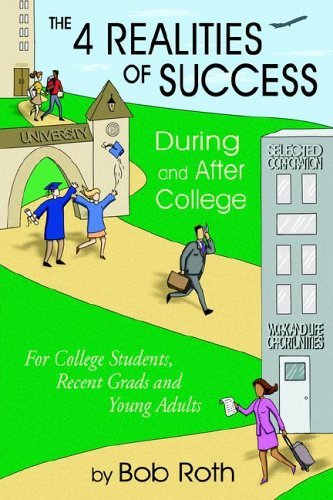
The 4 Realities of Success During and After College


Here is a self-help/how to book that tells college students about all the things they must take care of in order to be mate with success. Published by Authorhouse, (Indiana, 2005) Bob Roth’s The 4 Realities of Success During and After College is a guide for college students, recent graduates, and young adults, showing how to achieve success by a stepwise pursuit of the four realities of success. These are:

1. You can be more successful in college
2. It takes an effective job search to land the job you want
3. You can be more effective in your job search
4. Going out on your own shouldn’t be a rude awakening

Roth takes the pains to present his readers with 62 chapters, 7 appendices, a bibliography, and an index all that would leave no point practically counting in a successful career. The book offers advice on organizational skills as a student, intelligent job-hunting, fixing a stance in one’s first job, and living as an individual. There is enough information and advice on each point the author lists.

With all the advice and lists of innumerable things to care for, The 4 Realities of Success During and After College underwhelms as a book. A lot of repetition and redundancy is obtrusively thwarting the reader’s attempt to get along with it. Points are given patchy descriptions instead of full-fledged elaboration, resulting in a jumpy feeling. The reader is constantly stuffed with points and steps to follow and no passage is devoted to let him participate in the field being explored. A preachy tone is seen in which a voice constantly haunts you to do or avoid certain things. More importantly, three fourth of the book tells you ‘what to do or avoid’ but not ‘how to bring this about’. Part four (Going out on your own shouldn’t be a rude awakening) is more practicable and wisely construed than the other three realities where countless things are to be done without having any idea how to be motivated in their direction. In any case, the individual has to lose most (if not all) of his self if he follows half of what he is being led to. It’s like ‘be yourself or gain success.’

One thing, perhaps the only one that captures the interest and conveys wisdom is inclusion of quotes from really successful figures like R.W. Emerson, Oscar Wilde, Benjamin Franklin, Frank Tyger, and so on. One such from Albert Schweitzer reads ‘I do not believe that we can put into anyone ideas which are not in him already.’

ISBN: 1420844709

Availability

http://www.amazon.com/gp/product/1420844709/ref=sr_11_1/102-2041641-8032950?%5Fencoding=UTF8
http://www.authorhouse.com/BookStore/ItemDetail~bookid~30550.aspx

Tuesday, March 07, 2006

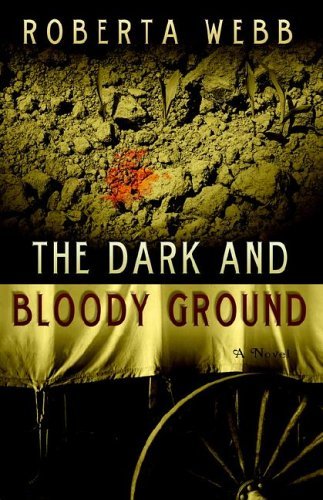
The Dark and Bloody Ground


Hailing from Jenkins in Southeastern Kentucky, Roberta Webb worked as a psychiatric nursing supervisor, continued her nursing at the University of Virginia, and worked for a short time on the first atomic bomb as a minute technician. Now, living in Texas, she has embarked on a writing career with her debut novel The Dark and Bloody Ground (TurnKey Press, Texas, 2006), a historical saga of a Kentucky family through its five generations.

The story starts with Morgan Collier’s irresistible fascination with the wild highs of Kentucky. As he settles there with his family, a full-fledged adventure lived in the open ensues with all the richness of natural vitalism. Adaptation to the wild, action against enemies both natural and human, and the harmony of love and force all constitute the history of life lived in and with the wild. Morgan’s progeny is fostered ahead in his daughter Sarah giving birth to Amy, she in turn becoming the mother of Ben Cantrell and the grandmother of Ben’s son Thomas. Zooming in on characters across generations, the author skillfully pilots an omniscient voice.

Webb’s experience of history contributes immensely to the realism of her novel’s story: the Bessemer’s Process for purifying steel, the Yamaha Pianos of the Japanese, details of mining and construction, and the craft of winemaking make an imagery of high appeal to evocation. Kentucky is slowly unmasked as the ‘dark and bloody ground’ where a wild innocence sheltered its inhabitants as early as 1840 until the arrival of investment for mining and Levi Cantrell’s obsession with making money and until after the Second World War. With the advent of capital and people, Levi’s lust for wealth drags him into bootlegging, and murder while the town is ravaged by competitiveness, theft, and worthlessness of man. The care for one’s family falls servile before satiating the masses’ craving for moonshine. The cracks widen and the Cantrell family is torn between losing their blood to war and keeping their faith in Mother Nature. A plot of its kind!

To involve the reader head over heels, Webb hooks the reader up on the supernatural trait of Ben Cantrell and his son Thomas. Both have got cat eyes, and in the words of Levi Cantrell ‘…cats have nine lives.’ Webb’s symbolism certainly conveys the power of nature in human life. To side with the wild is to survive in the eternally fierce world no matter what form wildness assumes. And hence we find Thomas Cantrell breathing his life while his peers enter their graves. Crueler is the case of Wesley Adams who is on a curse by Lettie Mullins, whose son he killed, that haunts her mind as he fears for the lives of his own sons.

The Dark and Bloody Ground is tout in its plot. It outstrips tautology except in the reminders that the old mountain people still looked healthy and beautiful despite their age. A couple of chapters are overly descriptive, exceeding plot and character, and zooming in on labor employed to urbanize Kentucky. But most of the 24 chapters are beautifully written. And at the end of the book you cannot help asking, with a sigh, Sarah Collier’s question, ‘How could a place so beautiful witness so many tragedies?’

ISBN: 1-933538-08-2

Availability

http://www.robertawebbauthor.com/

http://www.amazon.com/gp/product/1933538082/sr=8-1/qid=1141749235/ref=sr_1_1/103-4586751-4404639?%5Fencoding=UTF8

http://bookpros.com/bp_pages/bp_ap_release.php?book_id=19

Tuesday, February 21, 2006

Unscrambled Eggs


If a book is short and carries choice verse, few would leave it to a second sitting. Miami author Nadia brown instantiates this assertion in her first book of poetry Unscrambled Eggs (Publish America, Baltimore, 2005). A collection of sixty poems, Unscrambled Eggs is an artistic pluck in the floating stillness of mundane thought. A daring, dissenting return to self-respect is the upshot of Miss Brown’s poetry.

The individual poems in the book are short, each centered closely on a distinct point. Tone varies from aspiring to confessional, though never leaving the self-conscious position of a deserving soul in the broad social milieu. Themes explored are more humanistic, less illusory or sentimental, and crucial to one’s self-esteem. Social injustice in Sea of Poor (in a country of gold and ledger, lies a sea of poor), self-respect in The Lesson Learned (Yet I exceed, your scant recognition) an urge on poet’s art to be more than mere words in Liquid Muse (what good are handsome metaphors, when profoundness eludes your pen), the nature of skin-deep, lie-loving love in Unforeseen Affair (it was not maliciousness, that hastened you away, but truth), and many vital issues are taken up in a mere 70 pages.

Unscrambled Eggs defies the conventional, the prejudiced, and whets the human spirit with determination, hope, unyielding fidelity to one’s purpose, and confession of one’s own fallibilities. There is a strong penchant for a purpose in life, at times growing morose. But the poetess never fails in keeping hold of the softness that opens the reader’s unbiased ear. This is achievement.

The degree of freedom with which the themes involve us is maintained in the lack of absence of end rhymes, reinforcing the mode of free, unprejudiced writing. Alliteration is not ardently employed and rhythm solely bears the characterization of verse. Nevertheless, the balance is secured. Cadence is not perfect but melodious and smooth. A quality that cannot go unappreciated is the feeling of fullness in each and every poem; no brusque truncations.

The crux of Miss Brown’s book is enmeshed in two poems sparkling with brilliance. Suppose glances wistfully at the irreversibility of time and its damage.

‘imagine life as a chalkboard
where errors are erased’

And certainly, the title poem Unscrambled Eggs pictures the ‘holes of the size of mountains’ each of us has in his or her life. How assiduously we try to refill them, the task is no easier than unscrambling eggs.

‘but when will I learn
I can no more unscramble eggs
Than change the past’

Unscrambled Eggs is a gift to poetry lovers.

ISBN: 1-4137-8169-1

Availability

http://www.amazon.com/gp/product/1413781691/ref=sr_11_1/103-0439889-6193453?%5Fencoding=UTF8

http://www.publishamerica.com/

http://nadiabrown.com/

Sunday, February 19, 2006

Positive Energy


Veteran psychiatrist Dr. Judith Orloff ventures to spotlight practical Energy Psychiatry, her expertise, a blend of traditional medicine and subtle energies of body and mind in her latest book Positive Energy (Three Rivers Press, New York, 2005). Grounded mainly in the deep-rooted mystical traditions, Energy Psychiatry is a scientific transformation of abstract energy principles for the treatment of a range of everyday problems like anxiety, maladjustment, mood swings, sexual discontent, and the general stresses of life. That makes Positive Energy a book for almost everyone.

Dr. Orloff divides her book in two parts: Building your Energy and Creating Positive Relationships and Combating Energy Vampires. The first part offers seven prescriptions each showing a window to utilizing and boosting one’s subtle energy resources. The second part involves three prescriptions on creating positive relationships, tackling energy-draining people (the Energy Vampires) and tuning in to the abundance of joy all around. Personal experience and stories of her patients make an interesting vista of healing with positivism. What attracts more, perhaps, is the voice of celebrities like Jamie Lee Curtis, Larry King, Shirley Maclaine, and others commenting on their encounters with energy-draining situations. The essence of Dr. Orloff’s advice is her emphasis on staying in the Now that can be procured by some simple exercises, meditations, and mantra.

Given all the good points of the book, Positive Energy has its slack slots. The subject matter is not free of serious speculation. Myths of flowers blooming on the statue of a goddess in South Korea and intuitive premonitions of energy-sensitive people raise doubts. Some of the personal stories are redundant and sound like thrumming on the same string. The narrative mode too feels rather preachy with repetitive reminders of ‘I’ll teach you’, ‘I’ll show you’, ‘You’ll learn’ and so on. Above all, it is the view of existence through the hazy Lens of Energy that puts the author’s viewpoint to question.

A reference guide, brief overview, and an index aid the reader with choice passages.

Positive Energy’s interested readership is wide and varied. For a Type A person, it is a thing to seek. For a hard-shelled scientist, it is one to answer.

ISBN: 1-4000-8216-1

Availability

http://drjudithorloff.com/

http://www.amazon.com/gp/product/1400082161/ref=pd_kar_gw_1/104-2557843-3385568?n=283155

Thursday, February 16, 2006

Amaranth


The distinguishing merit of Michael Ehrenreich’s first novel Amaranth (iUniverse Inc, Nebraska, 2005) is its striking modern realism. A rich imagery of modern city environment, modes of life, and tearing stresses of disease and ugliness make Ehrenreich’s literary fiction a 21st century classic.

Amaranth bears a mature plot. The first 50 pages reveal so much that it’s hard to anticipate the thematic passages as something still on their way. But more comes than one can anticipate. One can tell from the start that the story is nucleated around disease and ugliness, both physical and beyond. Dr. Bing Denton is a surgeon with magic hands who is struggling to save his professional life by putting up with the ugliness of surgical procedures and his family life by trying to be a husband and a father. Standing at the dichotomy of hurting and healing, Dr. Denton finds his teenage daughter, Liza, pregnant in a drug-induced coma. The surgeon extraordinaire has a mind left that presses on itself to remember any of his wife’s friends who might tell him how to reach her and tell her about their child. So much for the sickness of life!

The issue raised in the novel is the quest of beauty by one engulfed in a hollow of ugliness. True beauty must be found and at once since ugliness is contagious as flu. The latter spreads through individuals while the former sweeps generations. And so we meet Ehrenreich’s symbol of beauty amid the sickness, the artistic Deborah who is going to lose her breasts and beauty to cancer. How she heals is the modern-day miracle, the amaranth, of Ehrenreich’s work. As one approaches the end, it gets harder to take the eyes off the spell woven in print. Spiritual self is probed with the lancet of words, an art peculiar to the author’s own experience in medicine.

The feeling of continuity in the narrative is one thing a good novel needs. In Amaranth the absence of page breaks and numbering or naming of chapters attains this, at least in part.

Amaranth’s audience is a mature, thoughtful, sensible adult who is ill at ease with the horrors of disease and ugly attitudes, a heart that seeks beauty in its pure form.

ISB: 0-595-36992-8

Availability

http://iuniverse.com/bookstore/book_detail.asp?isbn=0-595-36992-8

http://www.amazon.com/gp/product/0595369928/sr=8-15/qid=1139831604/ref=sr_1_15/104-8928828-5973567?%5Fencoding=UTF8

Thursday, February 09, 2006

Hidden Grace


Twenty years of Dr. Garland Roper’s experience as a psychotherapist have consummated in the from of a deeply disturbing, insightful, and healing book ‘Hidden Grace’ (Cliffside Press at OMNI, Maine, 2005). A literary novel, a psychological study of psychosexual torture and depression, a case against inhuman foster neglect, and a life-giving look at one woman’s courage in the face of brutal abuse, the merit of ‘Hidden Grace’ is hard to encapsulate in a single instance.

We meet old Grace Albright who revisits her middle-aged therapist Dr. Carl Wilder, a struggling modern-day Sisyphus wrestling with his ‘rock’ of confidence as a therapist, to help her write a book about their therapy. Dr. Wilder narrates memories of Grace’s writings telling, in her words, the story of her early life in foster houses. As Grace opens the chapters of extreme sadistic torture at the hands of her foster families, Dr. Wilder’s depressive view of his own life transforms positively. Together the therapist and the patient rise from their tombs and become living persons in their own flesh, no more given into the torture of slavery.

‘Hidden Grace’ may well be seen as a detective story in literary style. Grace’s unwillingness to speak of her torture kindles the curiosity from the prologue and keeps the flame aglow till the very end of the book. The development of her character, her self-concept as a sinner against herself, challenges notions of established moral concepts. The distinction between sinner and victim of sin is diffused until Grace makes Dr. Wilder (and the reader) see the light.

The language of Gar Roper’s narrative is anything but professional. More important is the narrative device, a combination of first person in Grace and Dr. Wilder’s voices, and Grace’s writings. Events are seen at once through the eyes of both the doctor and her patient. This chimes in with the theme of the novel, a story of participant roles integral to the therapy in question. The discovery and revival of the innocent and loving Grace is accomplished through the written word. That of Dr. Wilder follows and, who knows, of how many eyes and minds.

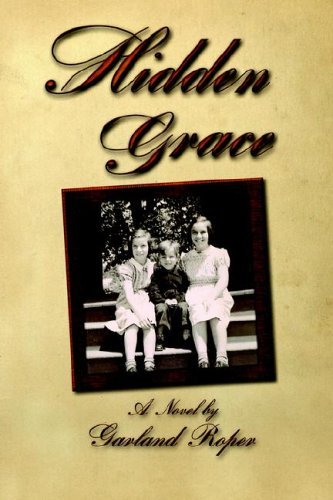
The impact of Grace’s indelible character is reinforced by the title page. The young girl on the left has face and eyes looking through you. Her beauty is indescribable and her terrors poignant, her sufferings violent enough to tear one apart. And yet Dr. Roper makes such a loving picture of her ripe age that Grace Albright becomes a symbol of convalescence.

The epilogue and author’s note reveal a few facts about the book, concluding with some inspiring words, which might sound rather tame in the face of the novel’s powerful hang over.

Hidden Grace is for us, lovers of beauty, courage, and truth.

ISBN: 0-9768276-0-3

Availability

http://omnilearning.org/HiddenGrace.html
http://www.amazon.com/gp/product/0976827603/qid=1139477886/sr=2-1/ref=pd_bbs_b_2_1/102-4044683-0948909?s=books&v=glance&n=283155

Sunday, February 05, 2006

Scars of the Square Needle


Dick Boucher is a Franco-American who gets himself caught in an alienating Navy venture as he tries to save himself being drafted for the army against Vietnam. What follows is enigmatic, humorous, satirical, and adventurous in Pierre R. Beaumier’s ‘Scars of the Square Needle' (Outskirts Press, Denver, 2005).

Beaumier’s anti-war fiction, a roman a clef, is hard to classify as a novel (who insists?) or a short story (there are over 200 pages). So that leaves one with a ‘protracted story’. Boucher’s character typifies the alienation of an army consign who once had a relationship with art. As the war ends, Boucher finds himself across invisible bars, parting him from the purity of peace. The plot is intelligently woven, though a little more intricately.

Humor tops the attractions of this story (should I?). Use of alliteration is frequent and it reinforces the effect: ‘big belly bobbing up and down’, ‘a beaky pinkish nose rose from…’ Beaumier’s fast tempo of narration baffles at times. You know it’s based on a first-hand account of Vietnam War, so you are looking for a strong personal voice. But that is lacking and you get instead a diffuse hum of many voices. Characters keep busting in and there are a few women on the scene popping up from nowhere to console the shivering Boucher after his nightmares. Most of these disappear brusquely.

Beaumier is likely to attract a large male audience, guys who love to hear about guns and rough language of the military. The actions scenes are thrilling; life runs far from a bed of roses, no matter how much the protagonist hankers after it. What’s precious about the end is that knowing the real scars of Boucher’s life proves far easier than all the babble about the ‘Square Needle’.

ISBN: 1-59800-002-0

Availability

http://www.outskirtspress.com/cgi/webpage.cgi?ISBN=1598000020
http://www.amazon.com/gp/product/1598000020/qid=1138890071/sr=1-1/ref=sr_1_1/002-1429089-8205637?s=books&v=glance&n=283155

Overcoming Runaway Blood Sugar


Dennis Pollock, author, evangelist, and the founder of Spirit of Grace Ministries, offers practical help for hypoglycemic, diabetics, people fighting fatigue and mood swings, the weight-conscious, and the general health-conscious reader in his recent book ‘Overcoming Runaway Blood Sugar’ (Harvest House Publishers, Oregon, 2006). Two qualities of Pollock’s publication distinguish its merit: informative and motivating.

In the foreword to Pollock’s book, Dr. Lee A. Brock defines runaway blood sugar as ‘uncontrolled serum glucose levels’. Pollock shares his own experience of the breakdown of blood sugar system and how he managed to subdue this giant. The informative part of the book has much to convey: two types of diabetes, three big problems of an average American’s health (sedentary lifestyle, diet, weight), common misconceptions about diets, high-carb versus low-carb food, and simple but important strategies to cope with blood sugar conditions.

More important perhaps is the motivational aspect of the book. As it goes in Pollock’s words ‘When it comes to making behavioral changes, motivation isn’t merely important; it is everything!’ By discussing three fronts of the situation (Diet, Exercise, and Weight), the health-conscious reader is thrown into resistance against blood sugar problems. It’s here that the author draws on his own experience as a diabetic to show that one can build power and self-control while enjoying life by shedding the riffraff in diet and lifestyle. Accomplishing so much in a mere 200 pages is indeed extraordinary.

Pollock’s book has adornments. There are short informative sidebars through most of the chapters. The nutritional value of different food items, proper ways of exercising, experiments with blood sugar victims, and interesting facts about food and habits are all included in a healthy mode. It’s a remarkable feature of a book that essentially takes a medical problem but interests the reader like fiction. Three appendices conclude the book: Spiritual Motivation, Sample Meals, and Low-carb Recipes of popular choice meals.

Overcoming Runaway Blood Sugar is for all readers, a must for those in battle with blood sugar illness.

ISBN: 0-7396-1721-7

Availability

http://www.harvesthousepublishers.com/books_nonfictionbook.cfm?ProductID=6917217
http://www.amazon.com/gp/product/0736917217/sr=1-1/qid=1139154334/ref=pd_bbs_1/102-4369681-4998524?%5Fencoding=UTF8

Monday, January 30, 2006

For Sarah


Is life a broken promise? A rusty chain? What about a bubble of fear inflated by an innocent kid who grew up to remember it was always there, all around? More questions make their way into debutant author Annie Harmon’s first work of fiction ‘For Sarah’ (Publish America, Baltimore, 2005).

‘For Sarah’ laces several first-person stories of Lee sisters (Angela, Samantha, Rachel, Amber, Jessica, Ash, and Tia) who fight the way of their life out of the horrors of an abusive stepfather. The impact of Harmon’s powerful narration combines with her psychological insight to explore a woman’s many forms of fear that is the fruit of an insecure childhood. As the girls turn into runaways, one by one, their adult lives fall a prey to worse calamities from unhealthy relationships and alcoholism, to attempted suicide and murder, and delusional psychosis in Ashlee (who is the writer of letters to Sarah). While their lives strive to reconcile with peace, the Lee sisters fathom the meaning of strength and weakness.

Harmon’s book is exactly the kind of work that hooks the reader from its prologue to the last word. Every single page is breathtaking; each and every sentence adorable. Harmon’s emotional narrative is a living, breathing story of woman seen through many eyes-those of the Lee sisters, Bridgette (friend of Lee sisters), Nicole (Ashlee’s daughter), Mica (Jessica’s daughter), and the mother of Lee sisters. One can see a daughter, a mother, a sister, a wife, a friend, and a woman living against and with men. And the picture is complete.

In the tradition of masterpieces, ‘For Sarah’ weaves a plot that ends with the last word of the narrative. Annie Harmon, in her author’s note, speaks of the tentative placement of the book in the category of fiction. It closely approaches an epistolary novel but has a mixed flavor of story collection, biography, and monologue. Ashlee’s letters to Sarah, a name she cannot assign to a specific person, produces the mist in the ambience of Harmon’s world. The reader joins hands with Ashlee in finding who Sarah is. The final answer is at once startling and cogent.

The end of the book incorporates a couple of nonfiction pages, those of ‘Questions for Discussion’ in which Harmon repeats the questions already bubbling up in the reader’s mind. The two most significant ones being ‘Why Tia is not allowed a story through the whole book?’ and ‘Who is Sarah?’

‘For Sarah’ is a touching book, raising tenderness and tears, and fortifying one against the shocks of hatred and rage. It is a book for every one who knows a mother, a sister, a wife, a daughter, a friend, and a woman. And who doesn’t?

ISBN: 1-4137-7010-X

Availability

http://www.amazon.com/

http://www.publishamerica.com/

Monday, January 23, 2006

Apart from You


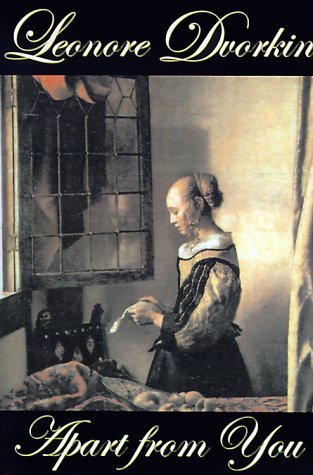
Leonore H. Dvorkin gives us a complex character, Elizabeth Nye, a 20-year-old student, developed along the lines of Jane Austen’s Emma. Only the latter was an unconsciously self-deceiving fool, while Elizabeth is always conscious to her selfish advances in love. Dvorkin’s novel Apart from You (Wildside Press, 2000) is yet another work of fiction that explores the mystery of love, though certainly not just another one. A 28-chapter account of Elizabeth’s five-week love relationship with Brian Petersen, a graduate teaching assistant, Apart from You gradually reveals the presence of many undesirable things in a web of relationships: lies, deceptions, betrayals, infidelities, jealousies, transgressions, and rivalries. No wonder the reader might find Elizabeth’s character self-contradictory. She hates her father’s infidelities but engages Brian in a nearly identical situation, given that she is engaged to the absent Alan Abrams while she involves herself with the naïve and unwitting Brian, who is ignorant of Alan’s existence. The deal between Elizabeth and Alan that they’ll have complete sexual freedom as long as they are apart imparts a momentum to Elizabeth’s character that gradually reveals her two greatest powers: her strength of reason and her open-minded generosity.

Growing up indignant regarding her father’s infidelity and jealous of her younger sister’s coquetry, Elizabeth starts as a hazy image of a young woman with domestic diligence and a craving for privacy. As her relationship with Brian proceeds, her character sheds its blurredness and stands clear as a cloudless sky in contrast to Brian’s own mist of conservatism. A frustrated and sentimental virgin until his encounter with Elizabeth, Brian believes himself incapable of the sort of dishonesty Elizabeth practices with him until just before she leaves him to return to Alan. In the end, Elizabeth forces Brian to recognize that under the right circumstances, he too might break with conventions of morality, as she and Alan have done. Elizabeth’s return to Alan has rich implications of real love and honesty, which are rarities in this story. Elizabeth loves Brian, and he loves her, but she cannot let him keep her forever, as she has already committed herself to Alan. In the final chapters, the truth comes as a shock to Brian, but Elizabeth’s careful reasoning masterfully defuses its threat. Elizabeth becomes a woman standing on her own feet and Brian becomes a man who will eventually allow her to do so.

Apart From You is tightly written, closely developed around one central theme. However, Dvorkin also touches on the dilemma of homosexuality. Elizabeth’s ‘sympathetic sex’ with her gay friend Stevie is one instance of it. Descriptions of Donnie and her lesbian roommate Jean sound insignificant until it is revealed what an important part Donnie played in Brian’s life and what brutality Jean survived. For a while, the story feels as though it’s digressing from its plot, till the central conflict resurges with greater force in the twentieth chapter.

A wealth of minor and cameo characters adds greatly to the depth of the novel: the beautiful widowed neighbor of Elizabeth’s parents, Brian’s deceased parents and his two very different sisters, sundry university professors, Stevie’s French lover, Brian’s beloved cat, and numerous others. Together, these side characters compel readers to ponder their own views on a variety of subjects: death, domestic violence, women’s changing roles in society, loneliness, the madness of war, the importance of animals in our lives, and much more.

The final lessons one hits upon at the end of the story are moving and profound: Love is wealth, and great wealth can be a burden. Playing with emotions is folly because they are stronger than one’s wits. Above all, it’s love, and not possession, that gives lasting happiness.

Like her nonfiction book 'Why I’m Glad I had Breast Cancer' (Wildside Press, 2005), Dvorkin’s narration of the story is smooth and touching. Bits of humor surface now and again as well. An unusual feature is that the reader is allowed to view almost every event through more than a single pair of eyes, hence the objectivity that forms the wormhole to comprehension.

Of course, it is an adult novel. While sex is integral to the novel’s plot, gratuitous sex is nowhere seen in the book, and each and every sex scene beautifully drives the story ahead to its climax.

To read the first chapter of the novel, see the Dvorkin website: http://www.dvorkin.com/

ISBN: 1-58715-074-3

Availability:
http://www.amazon.com/
http://www.buy.com/
http://www.wildsidepress.com/
_______________________________________________________________

http://www.wildsidepress.com/product.asp?itemid=183
http://www.amazon.com/gp/product/1587150743/qid=1137916182/sr=8-2/ref=sr_8_xs_ap_i2_xgl14/102-2389124-1515334?n=507846&s=books&v=glance

Wednesday, December 07, 2005

Emotional Intelligence: Why It Can Matter More Than IQ


Daniel Goleman needs no introduction. The former senior editor of ‘Psychology Today’ is widely known for his Vital Lies, Simple Truths and The Meditative Mind. His groundbreaking bestseller Emotional Intelligence ( Bantam Books, New York, 1995) is yet another landmark in the world of applied psychology. It extracts years of research on human emotions and their behavioral significance to emerge as a lovable book.

Goleman’s approach, as his typical, is demonstratively scientific with a natural appeal to common sense; case studies are nearly fictionalized for the reader’s interest, followed by explanations to answer the questions popping up in the reader’s mind. ‘Emotional Intelligence’ is thus essentially a solution-oriented work. By making explicit the biological nature of emotions-anxiety, fear, anger, and joy- it gets to the roots of problems raised by emotional immaturity. The approach is fruitful since problems whose roots are known are half-solved.

The book carries five main parts: The Emotional Brain (biological basis of emotions), The Nature of Emotional Intelligence, Emotional Intelligence Applied (emotions, behavior, and relationships), Windows of Opportunities (relearning emotions), and Emotional Literacy (educating people’s emotions). Appendices and explanatory notes make it a comprehensive edition.

Goleman regards amygdala, the almond-shaped structure above the brainstem, as the seat of all emotions, as contrasted with the ‘thinking brain’-the neocortex. In all cases of our emotional fits, the amygdala hijacks the brain; in a few cases the thinking brain gets time/chance to check the impulse. To refine our personalities of maladaptive emotional tantrums-that lead to problems small as a raging beat to fatal as suicide or murder-we need to strengthen our thinking brain. That this is possible, and experimentally demonstrated, is the crux of the book. Goleman tells of basic emotional skills like self-awareness; identifying, expressing and managing feelings; impulse control and delaying gratification; and handling stress and anxiety. These come from ‘emotional education’, which, according to the author, means not to avoid conflict completely but to resolve it intelligently before it spirals into a fight. And thus we come to know about the ‘Resolving Conflict Creativity Program.’ Goleman effectively epitomizes the point of ‘Emotional Intelligence’ in Erasmus’s quote: ‘The main hope of a nation lies in the proper education of its youth.’

With a number of interesting, exciting, pleasing, depressing, and surprising instances from real life, and some great quotes of wisdom, Emotional Intelligence is for everyone who has emotions and needs to know their intelligent use.

ISBN: 0553375067

Availability: http://www.amazon.com/Emotional-Intelligence-Matter-More-Than/dp/0553375067

Friday, November 11, 2005

The Cry for Myth


Renowned psychoanalyst Rollo May rediscovers the vitality of myth to our existence from a psychotherapist’s viewpoint in his The Cry for Myth (Norton and Co., New York, 1991). Defining ‘myths’ as ‘narrative patterns that give significance to our existence’, May stresses the phenomenon of myth making as essential in gaining mental health, particularly in our age of anxiety and disorientation.

May divides his book in three main parts viz. ‘The Function of Myths’, ‘Myths in America’, and ‘Myths of the Western World’. Even in the very first part, it becomes clearer that the author’s therapeutic illustration is yielding to historical and archetypal criticism of myths in literature. From ‘Oedipus’ to ‘Divine Comedy’ and ‘Gatsby’ to ‘Faustus’, May illumines his own talent beyond that of a hard-shelled psychologist, or scientist, and appears as a self-conscious existentialist commentator on myth and human life.

The merits of the book are manifest, as are its seams. May produces an easy English version of a topic otherwise vulnerable to philosophizing and linguistic complexity. The reader even need not have read the works being interpreted for the ‘mythemes’; a single passage masterfully compresses the plot. American life pattern of the day is probed in greater detail which, being a model for the post-industrial world, at first sounds a fair business.

Still, one cannot help thinking why whole three chapters have been devoted to the myth of Faust when a single, more compact one, would have sufficed. The implications of Oedipus’s myth are no less profound in our Narcissistic Age. An excessive treatment of American individualism might sound a little obsessed view, given the whole of Western World and May’s inattention to religious traditions of the West (Abraham, Joseph, Moses, Solomon, Christ). Then there are seemingly idiosyncratic terms coined like ‘Creative Waiting’.

The fourth part Myths for Survival virtually ends before starting. May’s cry for humans loving one another and be a great family of brothers and sisters sounds a little preachy (may be on account of a nonliterary plain language). One starts waiting for an extended version of this pastry since one is called on to love but never told ‘How’?

ISBN: 0393331776

Availability: http://www.amazon.com/gp/product/0393331776/

Tuesday, October 11, 2005

Why I’m Glad I had Breast Cancer


It is indeed the challenging title of Leonore H. Dvorkin’s latest nonfiction book ‘Why I’m Glad I Had Breast Cancer’ (WildSide Press, September 2005) that drives one to go for it. Only later does the reader feel glad for his choice as this short book makes a genuine case for looking at life in a positive light.

Dvorkin gives an account of her own experience of contracting breast cancer and choosing mastectomy for cure in the face of little social support, favoring her choice. Being a confident woman, well over fifty but physically strong, and a loving wife and mother, her account of life before and after mastectomy is remarkably unaffected and straightforward. Life came to her as a gift (being born three months premature) and she lived it in full swing, not surprisingly, more fully after her mastectomy. Not only does she retain her self-image of a healthy woman but also discovers the major factors responsible for the gross feminine self-concept with respect to breasts. A new image of the ‘athletic woman’ in American Society is thus born of Dvorkin’s genius.

An unsurpassed merit of the book is that the author is not bent on dramatizing situations. Emotional moments are narrated with their normal force: the news of having cancer, emotional parting with her elder sister before the mastectomy, the sacrifice to let her husband keep his fertility while she undergoes hysterectomy, and the loss of a breast versus more sorrowful losses that we all suffer throughout our lives. Dvorkin’s realistic style of narration adds enormously to the emotional impact of her story.

Lesson after lesson comes as a precious gift of Dvorkin’s brave encounter with cancer. We realize how others care about us; that shadows of suffering can be ousted with the bliss of intellectual achievement; that fear can be harnessed by reason; that aging is not the worst threat; that we must look at how far we can go from here instead of pitying over what we have been. Two great lessons of the book are most inspiring. First, real freedom lies in becoming one’s true self, ever freer of the expectations of others. Secondly, how to be self-conscious to the right degree and in the right way.

Dvorkin’s ‘Why I’m Glad I Had Breast Cancer’ is the gift of her wisdom and fortitude not to be missed by any woman in particular, and anyone in general.

ISBN: 0-8095-1096-0

WildSide Press: http://www.wildsidepress.com/product.asp?itemid=1228&catid=70
Amazon : http://www.amazon.com/Leonore Dvorkin’s homepage: http://www.dvorkin.com/

Wednesday, August 24, 2005

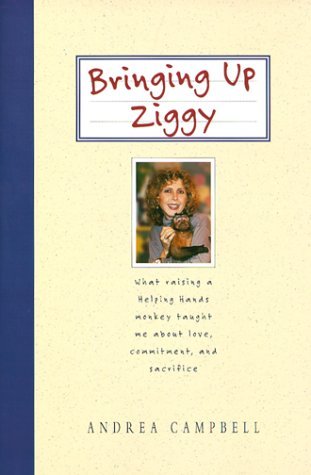
Bringing Up Ziggy: What Raising a Helping Hands Monkey Taught Me About Love, Commitment and Sacrifice


Amusing, inspiring, guiding, and educational are only some of the adjectives I can use to describe Andrea Campbell’s Bringing Up Ziggy (1999, Renaissance Books, Los Angeles). In memoir fashion, Campbell relates her experience as foster mother for a Helping Hands capuchin monkey. When grown, Ziggy will be trained to act as a helper/companion and will then be donated to a quadriplegic, someone who is paralyzed and lives in a wheelchair. The cause is admirable, but the immediacy of a baby monkey needing a mother becomes the foremost feature in Campbell’s book; a true, seat-of-the-pants tale that is more lovely than love itself.

Andrea Campbell’s account of rearing Ziggy is really a story of courage. And her courage is driven more by intellect, as she is a woman who tries to understand and incorporate the challenging joys of this new lifeform into her own life, while coping with the needs of a growing family. Like a juggler, she takes on the motherly role for this unique monkey-child and stays the course in spite of scratches, bites, and surgery, all the while still caring for her own young sons and husband, in addition to managing a freelance writing career. What more can a person pull off? But Campbell’s greatest achievement, which unfolds in this book like pieces from a time capsule, is the growth of her selfless love for this needy and complex furry child, her capuchin. Despite knowing that Ziggy will eventually leave her to be the helping hands and love companion to someone else, Campbell wholeheartedly accepts this weird, new motherhood adventure for one of our closest evolutionary relatives. Her bond with Ziggy becomes a symbol of love between primates, and a link for humans who fight for a life filled with meaning and important minutes.

As an author, Andrea Campbell tells a personal and well-thought out narration and her story has many funny bits. For example, she doesn’t miss the moment when a neighboring child who is fascinated with Ziggy asks, “Does she play cards?” And a sense of humor shows up spontaneously in her other observations: “…these are just a few reasons why this organization is so successful at training monkeys and handling people—two very similar acts.”

What moves to tears is by her gift of explaining certain facts that help the reader to realize that animals have emotions and a right to be respected too. In Chapter 7, she tells the story of Roger Fouts and his dear chimp Booee. Fouts, a primatologist, has lovingly taught sign language and nurtured Booee for several years when they are parted by politics and funding. Booee suffers 13 years of confinement in a biomedical research lab and will soon be reunited with Fouts, his parent and friend. Fouts, clearly in despair over the brief reunion wondered if Booee would remember him, and how he would act? Booee not only remembered his former friend, but he spelled out his nickname “Rodg” in American Sign Language!

In a chapter called ‘Ladder of Emotions,’ Campbell shares how she was blinded for three days because of an accidental corneal scratch administered by an exuberant Ziggy. She uses this instance of falling away from comfort to raise our level of compassion by feeling for all those who have lost the luxury of movement, sight, or hearing.

Bringing Up Ziggy also teaches us a lot about monkeys’ behavior and emotions, their capacity for learning, their extraordinary gymnastic abilities, and certain other qualities humans would do well to study. For example, Campbell notices an exemplary quality in capuchins with their urge for immediate reconciliation, one of their most powerful inclinations. She suggests that this quality could be better taught our own children, if we just left them on their own more often to resolve their childish disputes. And Campbell emphatically reinforces her argument in favor of animals having soul by saying: “And who thinks that animals have no soul? I personally believe it’s better to err on the side ‘for’ soul.”

Andrea Campbell is a savvy author in that she makes sure her book doesn’t sound monotonous by including her family’s viewpoints about Ziggy in the chapter ‘Other Voices’. There is also an amusing photo album at the end of the book. And certainly some great quotes at the beginning of chapters. Take for instance: “a man however well behaved, at best is only a monkey shaved!’

Bringing Up Ziggy is an adorable read. In a sense it is a challenging book: How can one resist falling in love with it?

Availability: www.andreacampbell.com

http://www.amazon.com/gp/product/1580630855/qid=1139834739/sr=1-1/ref=sr_1_1/104-8928828-5973567?s=books&v=glance&n=283155

Monday, July 25, 2005

Rare Earth: Why Complex Life is Uncommon in the Universe


ISBN: 0-387-98701-0

Rare Earth (2000,Copernicus Press, New York) begins as a challenging book from its introduction which defines the Rare Earth Hypothesis as commonness of simple life and the rarity of complex life in the universe. Peter D. Ward and Donald Brownlee claim that their hypothesis will reverse the decentering trend, namely that our earth is not the one planet with life but one of many. A renewed perspective of the long-held belief in the uniqueness of earth and its life.

Among the number of argued reasons for the unity of earth, with respect to complex life, are: earth’s proper position in space, a core at the earth’s center, ambient surface temperature, moon’s perfect distance from the earth, and so on. There is much information both in figures and in the form of historical evidences and reconstruction. All the facts indicate the scholarship of the authors who are bent on proving the rarity of our planet as the sole carrier of complex life.

What makes the book, and the hypothesis, debatable is the weight of the proposed rarity factors in relationship to the mainstream cosmology. Offering details of earth’s phenomena only confines one’s vision to our planet, as one is naturally inclined to do. It does not refute the numerous possibilities of such phenomena on other planets, lots of which might be enjoying the same or even better living conditions somewhere in the remote space. Should we consider earth rare only because we are unable to know about other instances? All the observable part of the universe (Moon, Mars, Europa etc.) that the authors mention for comparison purpose is indeed a negligibly small part of Carl Sagan’s or Stephen Hawking’s universe. The Drake Equation, used to predict the possible number of civilizations in our galaxy, is confined to a single galaxy, our Milky Way. How many such galaxies are there in the universe? The authors seem to be assuming too much in adding their own factors to produce a modified Drake Equation. Nevertheless, the founders of Rare Earth Hypothesis grant that many unknowns exist (structure of solar system, biogeochemical processes affecting the origin of life etc.) in the way of accepting Rare Earth Hypothesis at this stage of our knowledge.

Rare Earth is informative and challenging. It has a special appeal for those who tend to see intelligent life, as of humans, as something unique. Equally, it captures the interest of those who have accepted the main stream cosmological view on the existence of life in the universe. Most importantly, Rare Earth is a book that motivates to get tuned to all possible sources of information on the issue. Just a few months back, in March 2005, NASA’s scientists directly detected light reflected by two extra-solar planets. According to the news, at least 130 stars outside our solar system have been shown to have orbiting planets. A curious mind can hardly keep from thinking what number of planets might be in the whole universe. In the context of such, and possibly coming, discoveries we might ask ourselves Is our life indeed a rare phenomenon?