Friday, November 09, 2012
Writers on the Edge
Tuesday, October 02, 2012
Black Cow
Wednesday, March 21, 2012
Out of Darkness: From Turmoil to Transformation

If you are one of those searching for the true meaning of happiness, one book you must not miss reading is Steve Taylor’s Out of the Darkness (Hay House, 2011). This book brings clarity and understanding to our otherwise misunderstood ideal of happiness, looking at the concept of happiness from a psycho-spiritual angle.
Taylor, a psychology lecturer in Britain and author of the best-selling book Waking from Sleep, has included in his book true studies of people, some of them widely known for their excellent work or achievements, showing their transformation to a state of peace and positivity after experiencing trauma or turmoil in their lives. These “shifters”—as termed in the book—changed for good, no more taking life for granted but valuing each moment of it as a joy in itself. Whether it was some terrifying physical accident, intense emotional crisis, or a close encounter with death, the trial in life paradoxically worked wonders for the shifters, whose entire perception of everyday life and personal involvement in its activities derived new meaning—a state of deep satisfaction and harmony with all that is there.
What precisely could cause such bliss is explained by the author in terms of our psychological structure. The book explores the role of ego in human perception and attitude. Ego is held at the core of the quest for doing more, going for the mundane, and to have more than is there already—leading us to unfulfilling, presumed points of happiness. But after the sufferings or coming face to face with death, the ego is beaten down and its shell of possession around our mind is broken, liberating the inner self to true happiness and fresh appreciation of life.
Out of the Darkness has many important lessons for its readers and answers to many important questions, including but not limited to:
Difference between religious conversion and spiritual transformation
Breaking attachments for attaining happiness
Psychotic states versus higher states of consciousness
Spirituality after substance abuse
Work, relationships, and spirituality
Freedom and happiness
Steve Taylor’s book is inspirational, informative, and full of hope. In our times when each day comes to millions as a challenge to make more, Out of the Darkness shows what it really means to make the most of our lives each moment. This book is without question a must-read for everyone.
Amazon Link: http://www.amazon.com/Out-Darkness-Turmoil-Transformation-Taylor/dp/1848502540
Author website: http://www.steventaylor.talktalk.net/
Saturday, December 31, 2011
F.N.G

Donald Bodey’s war novel F.N.G (new revised edition from Modern History Press, 2008) tells a story of a Vietnam War veteran in his words. The book depicts the psychological impact of traumatic war experiences on a young soldier, or F.N.G—the military slang for ‘Fucking New Guy’.
The protagonist of the novel Gabriel Sauers, after accidentally shooting his grandson in the foot while hunting in the wild, remembers his arrival in Vietnam as a draftee. Through his eyes, the readers see the miserable living condition of the soldiers in a land that is far from home in every sense. With time, the uncertainty of life in the war zone accumulates as Sauers witnesses many a trauma including the death of his fellow soldiers and the ugliness of the world’s most dangerous and senseless situation—kill or be killed.
The narration is raw and imparts the closeness of the misery, physical and psychological, that a newcomer experienced fighting in Nam. Bodey’s writing skill is concentrated in the imagery of the places, people, and situations that constituted the frightening experiences of its leading character. In this book, you not only read about the Vietnam War, but you see the war, smell the rotting life affected by it, and hear the silent cries of the souls thrown into a pit of horror. And by the time you get to the novel’s end, the suspicion of whether Sauers really shot his grandson accidentally makes you think twice about the deepest scars war leaves on those who “fight” it.
There’s quite a bit of military slang in F.N.G, reflected in the title, and the author has made available an online glossary on his website. While may not be an enjoyable book for many female audiences, for all people interested in serious war fiction, this novel is worth reading.
ISBN: 978-1932690590
Availability: http://www.amazon.com/F-N-G-Revised-Donald-Bodey/dp/193269059X
Author Website: http://donbodey.com/
Monday, December 19, 2011
American Elegies

“Hype over substance” is the new American motto as readers are told in the prolegomenon of American Elegies (World Audience Publishers, 2008). The poet, Louis Phillips, has mourned this degradation in a unique, America-centric verse.
Phillips’ view takes for its reference Johnny Inkslinger (Paul Bunyan’s smart chef), implying a sharp eye and good consideration for the subject adopted into verse. Johnny Inkslinger engages in virtual travels, rendezvous, and memories of people, places, things, and events—all American—that left a mark on American thought. Battles, Native American land and animals, Hollywood, sports, politics, art and literature, and more—Johnny Inkslinger makes sure not to miss on anything.
The mood of these poems is mostly contemplative, and not plaintive in the more traditional, classic elegiac style. Some poems read much more critically, a few even getting satirical. But the imagery, mostly from memories of past American events, things, and places, dilutes the mood sufficiently to impart the feel of an adventurous, slightly nostalgic travel in what America has been; in what it has seen.
What makes it difficult for an average, and in particular non-American, reader is that these poems are full of allusions (not unexpectedly) to American history, icons, culture, and literature. A well-read reader, however, with sound knowledge of Americana will surely find it a treasure of thoughts connecting America’s past and its present. The ending of the books is more overtly plaintive: disappointment in America’s lack of morals.
ISBN: 0982054009
Availability: http://www.amazon.com/American-Elegies-Louis-Phillips/dp/0982054009
Thursday, December 01, 2011
Wisdom to Wellness

The traditional medical system treats only the symptoms of our health issues and for this, we spend a lot of our income/savings, without getting to the root cause of the problem and fixing it for good. In this book, alternative-holistic therapist Maureen Minnehan Jones shares with her readers the essence of her successful healing techniques as well as the theoretical framework for addressing the root cause of disease. Jones educates readers on the often-ignored side of all disease—our emotional self and its deep relation with our life energy, which manifest in our physical condition.
Maureen Jones’ work shows that disease is not something reducible to an external biological agent (the generally believed germ theory of disease); rather it is an expression of the deeper inner needs which have been left unattended and, quite often, suppressed. We often fail to nurture our souls with the love and trust we require each moment, leading our bodies as well as minds to a condition where they lose their natural, healthy state. How to get them in order with simple, yet vital attitude and practices is what Jones’ book achieves.
In separate chapters, Wisdom to Wellness explains the nature of a number of the most common and dreaded diseases—cancer, heart disease, HIV/AIDS, arthritis, Alzheimer’s, and Hepatitis etc—and what needs to be done to prevent and/or treat them. Each chapter on disease has one or more case studies giving an account of what it means to suffer from that condition and what it takes to get over it. The author’s writing is very organized and smooth, and it involves the reader deeply in the book’s chapters. Each chapter starts with a memorable, wise quote. The effect of the book is uplifting and its message is assuring, i.e. we can be take control of our lives if we want.
Wisdom to Wellness deserves recommendation for anyone who cares about their health, wellbeing, and quality of life.
Availability: http://www.amazon.com/Wisdom-Wellness-Emotional-Sufferings-Physical/dp/184694399X
Saturday, October 15, 2011
Ideas and Jellyfish
Professor Askin Ozcan has named this collection of his stories and reflections Ideas and Jellyfish (Prakash Books, 2011), after one of the creative nonfiction pieces in the book—the comparison being that ideas are elusive, just like jellyfish, slipping away the moment you touch them.
The items in this book are full of wit, humor, and adventure, though not all chapters are equally exciting; some are rich in creativity and thought; some are rather plain, like usual observations. Many stories are based on the author’s adventures in different countries and cultures (Professor Ozcan being a widely-traveled person). Interesting coincidences also make some of the real-life stories more attractive. At the end of the book are some fresh jokes.
The best story, which is also the longest in the book, is undoubtedly Please, No Serious Business! Full of humor, fantasy, and gentle satire, it describes the formation of a political party consisting of comedians, who win the national elections while sticking to their motto of making people laugh. In imagination, humor, and mood, it emulates the author’s previous gem The Second Venice. This story alone makes good reason for all lovers of amusing fiction to get the book and see how far the author’s imagination can take them.
Call it the work of wit, Professor Ozcan’s amusing ideas presented in this collection aren’t so shy as jellyfish. They are likely to remain with the readers for quite a while after they have finished reading the book.
ISBN-13: 9788172343736
Availability: http://www.egully.com/products/Ideas-%26-Jellyfish-by-Askin-Ozcan.html
Thursday, September 29, 2011
Skive: The Short Story Quarterly—December 2006

Skive magazine by the Mockfrog Design Press (Australia) was a quarterly of short fiction presenting the work of writers from around the world. The second issue of the print version, published December 2006, includes 28 short stories from as many writers. The anthology covers a broad range of themes, styles, and moods, making a kind of a literary map of the world’s voices in storytelling.
Most of the stories in this collection are quite interesting—some, like Pankaj Challa’s Padma, inspiring compassion; some sketching a case of critique of art (e.g. The Finished Symphony: A Fable); while a few, like Hidden Monsters by Donna Johnson, showing the not-so-invisible dreads of human life that are not scary, to surprise all. There is some great, refined humor in a few stories, J. R. Salling’s Bird is the Word being the best of them. Of course, there are quite a few outright crazy ones too, like M. Wilkinson’s The Eclipse.
This Skive anthology is lovable for its diversity, literary taste, and storytelling skills in various genres. The magazine has been publishing online, and later in print, for a number of years. This issue is available online at Lulu. Editor Matthew Ward is now starting a new unique magazine called No Printer Zone wherein he means to include hand-written work—stories, poems, and visual art.
ISBN: 978-1-934209-13-4
Availability: http://www.lulu.com/product/paperback/skive-magazine-quarterly---issue-2-december-2006/604629
Tuesday, September 27, 2011
The Death of Pan

Our existence in the world as humans having bodies and minds is defined by a perpetual quest for making sense of life—through expressing and concealing, as well as interacting with various elements, both internally and outwardly. More than anything else, we are instinctively drawn to defend our ‘self’—that which is considered and felt as the valuable and, in a more metaphysical sense, the sacred. Tom Petsinis’ The Death of Pan (Penguin Books Australia, 2001) engages readers in 16 compelling tales of the characteristic human anxiety, which makes the base of the continuum connecting the biological instinct of self-preservation with the learned aspects of living in society.
These stories grab your attention since the very first page of the book in that the author takes you, the reader, as his protagonist—the tales all narrated in second person. The nameless main character “you” becomes an everyman in different geographical and social settings and experiencing various situations with a heightened consciousness, mostly getting increasingly anxious as the veneers around the protected self peel one by one with the unfolding of the events in each story. Comparing the human sense, or spirit, of protection with the Greek god Pan, Petsinis subtly strips his readers of their illusion of the human being the advanced species—traditionally perceived as reflecting the image of god—with a touch of irony. Man’s story starts out well, with hope and passion, but not for long. The illusion dies, as does Pan (the only Greek god who really dies, as the mythology goes), and what follows is beyond description—just the end of the story, as in Petsinis’ tales.
Though Petsinis’ themes and characters are more generic, his characters—or “you”—are men with a passion for the artistic, intellectual, the exceptional; they are mostly aspiring geniuses and masters of a craft or skill—individuals more than willing to shoulder the heavens. Whether they are really up to it and how they will soon worry about saving themselves from the fierce force of life make the element of interest in the plot of each narrative. In some of these stories, Anorexia for example, the causal or thematic connection between events is rather obscure; in others, it shows in each line. Stories like The Ultimate Prime and The Lion Tamer are sharply focused gems of meaningful narrative wherein readers are taken right on to the thin line between achievement and doom. One story, The Predator, instantiates the art of good story-telling and the value it holds for the storyteller—literarily and commercially.
The only thing that may bother the reader of The Death of Pan is the monotonous narration in second person. A voice, not yours, telling that you did this and went through that feels imposing at times. On the whole, however, Petsinis’ stories are not to be missed. It is a literary treasure, timeless and invaluable.
ISBN: 014100424X
Thursday, July 21, 2011
Dark Side of the Universe

The origin and evolution of the universe has been the subject of many a publication since Stephen Hawking’s A Brief History of Time became a bestseller. For the most part, these books—written for the general educated reader—have remained informative on popular concepts discussed in Hawking’s book: elementary particles, black holes, expansion of the universe, and fate of the universe etc. But few have zoomed in on the invisible, or dark, components of the universe and the kind of research being conducted to discover its nature. Here is a book that takes its readers on an interesting trip around the hidden side of the universe—Iain Nicolson’s Dark Side of the Universe (Johns Hopkins University Press, 2007).
The author of the book starts with basic concepts of cosmology—like stars, elementary particles, black holes, and the basic physical forces of nature—and then skillfully moves on, deeper and deeper into discussing the less known realms of the universe. Each chapter details important research studies and experiments, answering questions that arise naturally from the discussion while new questions surface for the following chapters. The most important and interesting of the topics is that of dark energy. We learn from the book that, just like dark matter, the new standard cosmological model of the universe also includes dark energy as a major component of the universe. In fact, it is now considered the largest component, followed by dark matter, and finally the visibly matter and luminous energy.
Since the ultimate fate of the universe depends on the relative abundance of its various components, Ian Nicholson’s discussion of dark energy is relevant to the big question of why our universe will end one way or the other. This aside, detail of the scientific method applied in research on cosmological concepts is a prominent and attractive quality of this book, which informs us on what significant research projects are currently underway and what kind of knowledge they are expected to bring in the coming years. Nicholson remembers to trace various developments to their discoverers or key researchers.
And of course, the glossy print and high-quality, colored illustrations make the book an eye charmer.
For any reader interested in science, particularly cosmology and physics, Dark Side of the Universe is highly recommended.
ISBN: 978-0801885921
Amazon Link: http://www.amazon.com/Dark-Side-Universe-Matter-Energy/dp/0801885922/
Tuesday, May 31, 2011
Whose Cries are Not Music

Nature, emotions, and life – all define Linda Benninghoff’s poetry, which has the immediacy of observation as well as constant invitation to thought and consideration. Of her latest poetry collection Whose Cries are Not Music (Lummox Press, California, 2011), Jim Knowles writes so aptly in his introduction to the book: “Linda is direct and earnest with her entertainment of the natural world to speak for her life.” This book of poems has more to say than her earlier, shorter works, like Departures wherein she has been more thematic.
Benninghoff’s involvement with nature shows in almost every poem of hers, even if she is showing us a scene from human life in the city. Whether it’s an animal or a tree, a sound or a ray of light, for this poet of nature, it’s a mirror reflecting our lives, making us conscious of it. We see barren and cold grounds in The Poem (p. 66) trodden by deer that are full of life, their energies stirring the inner, dormant music in our spirit. In The Sea (p. 70), nature comes as a living and life-hosting whole. In yet other poems, like The Seal (p. 32) and This Cat (p. 77), we learn valuable lessons in independence and endurance from animals smaller and weaker than us in the physical sense.
Memories are a key component of Benninghoff’s poetry, more so in this book, which is laden with nostalgic scenes relived in the poet’s verse. Memories of friends, family members, natural scenes, and dreams – things that meant in and for life – all render the poet’s scenes of emotional experiences come alive with the sense of a living self, still moving through time consciously, albeit precariously. Some of the memories are depressing, of dying and/or dead friends and family members. But the special quality of memory is that each one is distinct – having an identity of its own within the mind bearing it.
The eponymous poem Whose Cries are Not Music (p. 51) is one the most painful poems in this collection. Pain born with life has been depicted in a gloomy mood by the poet, conveyed in the cries of geese that have traveled miles and can make only one sound, like “a child who has no words and will cry without stopping”. Constant motion through life and nonstop change make life less certain, but, paradoxically, give it the meaning it has.
The final section of the book, called “After Death”, combines nature, life, and dreams poetically in a rather metaphysical mood. It is here that the staring look of a deer gives us a glimpse of life’s frailty. The poem Dance (p. 99) literally equates death with the attempt to reach a dream that is no longer here (on earth). The last poem In Dying (p. 100) goes on to ask, “Don’t we reveal in dying who we are?”, including the remarkable analogy of husk coming from seed.
Throughout her poetry, Linda Benninghoff maintains the sense of life and our neglected treasure of consciousness of nature. Her imagist portrayal of life’s wild and tame aspects neatly assimilate the spirit of romanticism without losing the stark realism of the modern times that presses itself poignantly on the minds of writers who value life and stand for peace. Whose Cries are Not Music is the book for lovers of poetry of, and for, life.
ISBN: 978-1929878956
Amazon Link: http://www.amazon.com/Whose-Cries-Are-Not-Music/dp/1929878958
Friday, March 11, 2011
Harmony – Celebrate Age (February 2011)
By good chance, I happened to search for Tina Ambhani, former Bollywood star (known as Tina Munim then), and found this wonderful magazine she has been editing. Titled Harmony: Celebrate Age, it is all-things-silver, a complete gift for the senior citizens and those interested in issues relating seniors – or ‘silvers’ as they are called.
The February 2011 issue of Harmony includes many inspiring stories about the great work silvers in Indian have been doing ranging from art and green living to activism and humanitarian initiatives. The content is diverse and engaging, and it does away with the ingrained stereotype of aging as something that takes the life out of you; through these stories, you realize what potential silvers enjoy in living positively and harmoniously with the gift of life.
Beside the feature stories, the magazine includes news, reviews, tips, and essays that are informative and practically helpful. Even the ads look fresh and purposeful (one in this issue tells silvers of a hip cell phone customized toward silvers’ special needs). Here we have a complete silver potpourri that is perfectly capable of emulating any high-quality international publication. A must read for any and everyone!
Browse the magazine’s issues at http://www.harmonyindia.org/.
Friday, March 04, 2011
Omm: A Collection of Plays and Monologues

As a literary form, plays have long enjoyed the supremacy of the uniqueness in which they combine the artistic, literary, and visual elements of creative expression for portraying the human condition. Creating mature, thought-inviting plays is the legacy of gifted writers, including our playwright here – Hugh Fox – whose collection of plays and monologues Ommm (World Audience Publishers, 2007) presents the passions, confusions, illusions, and disillusionments of the modern human.
Hugh’s plays – making the first, and larger, part of the book – are pithy, often themed on age, aging, and related thought transformation in people of different cultural backgrounds and diverse sensibilities – mostly Americans and others of the white race – in relation to their self-image and associated adjustments or reactions to changes that time sanctions with universal authority. Several of Hugh’s characters are aging men and women who are realizing and still exploring the physical limitations of their being, leading often to increased rumination and often increased acceptance. At the same time, they get lessons against taking things for granted. The characters Bert and Dolores of First Corinthians speak it out most expressively: “Every day is a miracle of survival for me.”
Although milder than one would expect (especially a young reader), the anxiety of aging shows in most of these plays. Hugh’s aging characters are aware that the count up the scale of time is inevitably a count down the slope of life where the final landing is death. But few of the characters tend to panic; instead, the advanced years imply for them more time for pondering, reminiscing, and resolving internal conflicts and reassessing personal values, albeit experiencing increased dependence on physical aids combined with the emptiness of being. Thus, the Hopi saying “No one ever has enough to retire,” is applied in one of the monologues (No. 13) in the context of old age as a time when you need lots of strength to cope with the emptiness of a life where you sleep less and have little to do whatever you are capable of doing at that age.
It is more in the monologues of Hugh’s collection that we feel the aging characters resorting to religion and spirituality (mostly depicted with the traditional superficiality), particularly in thought. But above that, these voices ask some really interesting questions: “How could anything begin from nothingness?” “Do animals think a lot about death?”, and others like these. The final monologue concludes the work at once convincingly and cathartically as the sole character of an aging man, after expressing his wish to have a sudden death, free of long suffering by illness, steps down to walk down among the audience, saying “… the real me walking by real people.” For Hugh, as long as you feel life, it is life and not death that is real. This is what the divine sound ‘ommm’ means to us.
Ommm is one of those literary gems that lovers of literature and humanities wouldn’t like to miss. Coming from the pen of a gifted writer, these plays and monologues are your food for thought and the light for your soul.
ISBN: 978-1934209264
Amazon Link: http://www.amazon.com/OMMM-Other-Plays-Hugh-Fox/dp/1934209260/
Saturday, February 26, 2011
God Soul Mind Brain: A Neuroscientist's Reflections on the Spirit World

Consciousness is the perhaps the most important common ground for psychology and philosophy, explored best through writing, to say. The traditional belief of a soul – an immaterial, conscious entity responsible for all observable behavior and subjective thinking processes – has long been rejected by adherents of reductionist approaches in science. Some, however, had the guts to actually relate the immaterial concepts to their material origins inside the body, and specifically in the brain, for psychological phenomena. Michael S.A. Graziano puts his expertise in neuroscience and his art of writing to work together in explaining how our immaterial, social, or spiritual concepts are created by our nervous system as explained in his latest book God Soul Mind Brain: A Neuroscientist's Reflections on the Spirit World (Leapfrog Press 2010).
In easy, clear language, and with helpful examples, Graziano allows the reader to understand the basic mechanisms at work in our nervous system while we experience the reality around and inside of us. He shows how particular areas in the brain function as a system to create perception, including social perception of immaterial entities – god, soul, and morality – which to our understanding are as real as anything. This doesn’t discredit any beliefs as nonsensical or intrinsically false; rather, it shows how all of us own the unique gift of perception that is capable of creating and sustaining the realities that we all need and live (even die) for. Best of all, our realities are essentially alike on the perceptual level; none is more scientific than the other, which is why we would respect science, or neuroscience specifically, as an egalitarian platform.
God Soul Mind Brain is a relatively short book which gets straight to its topic. The way Michael proceeds to let his readers explore the connection between brain, perception, reality, and culture speaks for his enviable teaching skills and clarity as an author. Provided with a list of recommended readings, this book will be worth reading for anyone interested in psychology and philosophy, especially the mind-brain discussion. And it will be a good pick for readers who like informative, interesting topics in science.
ISBN-13: 978-1935248118
Amazon Link: http://www.amazon.com/God-Soul-Mind-Brain-Neuroscientists/dp/1935248111
Sunday, January 09, 2011
Rabies Mom

Being a good parent has been a popular topic in countless publications and, more recently, on blogs and in e-zines. In contrast to the title cover’s spooky image, Rabies Mom (Rabies Mom LLC, 2008) by Pat Carroll and Jack McGowan begins like a man’s pile of complaints against his wife, unloading suddenly on your attention. But as you read on, the story of his suffering shows the set of important messages in the book.
Pat Carroll tells about his family life, with a wife and six kids, which started falling apart when his wife decided to divorce him in order to seek “happiness”. Pat’s immediate concern was the well-being of his kids who were given into his wife’s custody by the court while he was made to leave the house and pay for the children’s expenses. Then, in October 2006, Pat’s worst nightmare came to plague his life when he received a call informing him that his 10-year-old daughter Shannon was in hospital because of some serious illness. The latter very shockingly turned out to be rabies – Shannon had been bitten by a bat while living with her mom. But was it only the wild bird that caused the threat to Pat’s child?
While Shannon struggled in the hospital’s intensive care for her life, Pat tried to discover what actually happened to Shannon while she was at her mom’s and how the mother’s criminal neglect could be proved before the judicial system in order to save the lives of the younger kids that were still in her custody. The important message in the book, therefore, draws the reader’s attention to the role of a passively (?) abusive parent not only in breaking the family apart but pushing a child of one’s own into the jaws of mortality.
Pat’s story also criticizes the US judicial system that is so blindly prejudiced in favor of women as to assume without reason (and persist in doing so) that mothers can take better care of their children. Carroll’s story is powerful, poignant, and, above all, important for all parents to read carefully. In his author’s note at the end of the book, Carroll tells that this book’s purpose, beside telling Shannon’s story, is to “open people’s eyes to the injustices in the US legal system”, especially in matters of custody of children by their fathers.
Rabies Mom is an important book and every parent and would-be parent must give it a reading, particularly those who suspect or have observed signs of psychological disturbance in their spouse/partner.
ISBN: 0980110602
Availability: http://www.amazon.com/Rabies-Mom-Jack-McGowan/dp/0980110602
Sunday, December 12, 2010
Chinese Blackbird

Sherry Quan Lee’s poetry is mainly focused on ethnic experience as an Asian/African-American living in America. Her poetry book Chinese Blackbird (Modern History Press, 2008) bears close similarity in theme and modes, to her other poetry book How to Write a Suicide Note (Modern History Press, 2008). One perceptible difference is that of tone. How to Write a Suicide Note sounded more poignant and exuding the feeling of ethnic discrimination and identity crisis to the extent of leading one to suicide attempts. But Chinese Blackbird sounds more involved in self-expression and story-telling. Some pieces in this collection are in fact written in prose with the poetic feel coming through loosely maintained rhythm.
After a very warm, inviting preface by David Mura, Sherry Quan Lee’s very first line, “I’m pregnant with myself”, speaks her inner urge of having another birth, a sort of inner rebirth by conscious choice. There come poems then which question the arbitrariness of blackness, the biases gearing the judgmental process, and the deceptive standards of identity (based mainly on skin color). Some of the questions are quite broad and would challenge the intellect as a whole: “Is it too late to break silence?” “Am I the woman I’m in love with?” There is enough in this collection to spark some meaningful discussions.
Chinese Blackbird also tells more about the author’s family and her experience of family life as well as relationships. And at more than one place, it rejects men on different grounds. This is not to say that the poet sounds phobic of men without reason. But her interior self seems to express a greater trust of women, epitomized in the poem “Naming” where her tribute to her mother shows why she ultimately can trust a woman, and with good reason. Maybe, men would like to question her position, but they have to beat the poet’s inner voice with stronger reason and at least equal poetic talent.
If How to Write a Suicide Note was an uplifting book standing for the value of life against adversity, Chinese Blackbird is a poetic picture of the strengths of one’s interior and the possibility that one might find success with living by being true to one’s inner self, even if it implies looking at one’s face in the mirror with no social makeup on. These poems are important in addressing both personal and social aspects of life in a multi-ethnic society.
ISBN: 978-1932690682
Availability: http://www.amazon.com/Chinese-Blackbird-Reflections-America-Sherry/dp/1932690689
Wednesday, December 08, 2010
Ticket to Ride

This book is interesting and important in many of its qualities. Primarily, the author Philip Scott Wikel, shows that back in the 60s, with things turning upside down and inside out in individual and social lives in the developed west, two young people didn’t let their sanity detach from the normal and traditional, while also moving ahead with a new spirit of the age. Morgan and Livy – the main characters – are thus simultaneously conventional and unconventional youth of a time when breaking the convention was becoming a rash convention in itself.
Ticket to Ride is a work of great creative and artistic merit, especially when you consider the different styles of narration so flexibly and with perfect literary ease blended together such that various stories set in different times and places are read as self-standing events, and yet are expanded upon later to arrive at a complete end without expressly answering the questions that arise in the reader’s mind. The stories are mostly showing than telling, something highly desirable in literary fiction.
The lead characters hold life and warmth of living it as a dream. A few are unique or quirky, like Psalm, until you actually see what led them there. There is lots of imagery in the book, and the experience of reading really emulates a ticket to ride in the literal sense with descriptions of travel presented in the style of literary journalism, beside journal entries by the main characters. Morgan and Livy also love to fantasize, so much so that Morgan finally has a brief conversation with Herman Melville along a beach. Imagination and love for wisdom at its peak!
Also enjoyable are many snippets, excerpts, and quotes from celebrated works of literature and most popular songs (Beatles remain alive throughout the book). If one must name any weakness of the book here, it must be the typos that are spotted here and there. But the charm of the book is not in the least shadowed by them. From page one to the last line, Ticket to Ride is a treat for the reader with the taste.
ISBN: 1450588271
Amazon Link: http://www.amazon.com/Ticket-Ride-Just-Another-Day/dp/1450588271
Sunday, November 14, 2010
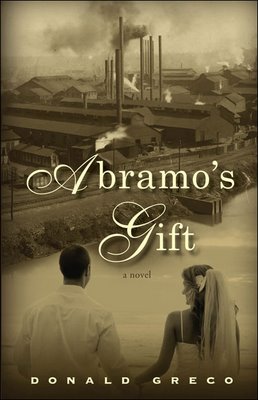
Abramo’s Gift

Donald Greco’s novel Abramo’s Gift (Bridgeway Books, 2008) tells the story of a young Italian Abramo Cardone who moves to America after losing his wife and infant child in a brutal crime incident committed by soldiers in his home country. Arriving in Ohio in 1918, he finds a new place to work and live, not knowing what destiny has in stock for him. As the story proceeds, Abramo suffers another trauma but recovers to a fuller life that has love, belongingness, and even more money than he could think of.
The story on the whole makes an uplifting book with a high value placed on love, respect, and care among the many characters involved. However, the lack of balance is excessively felt throughout the book. Characters, which seem far more in number than needed for a complete story, are not developed well as the story proceeds. There is little real conflict, no climax, and a pretty fulsome ending that annoyingly zooms in on making everybody feel happy and look nice and safe. There is virtually no humor in the nearly 300 pages, making the story feel quite dry. Above all, the novel’s hero – Abramo – feels like a passive, ignored character that is hardly shown doing anything at all (not even speaking).
Chapters in this novel are usually short and there is a lot of telling than showing throughout the plot, resulting in the undesirable ease with which one can guess what’s coming. The only significance of the novel, apparent to me, is a picture of multi-ethnic social setting in early 20th Century America, mostly comprising Italians and Irish immigrants in the area where the story takes place. Though not thoroughly explored, what they did and how they lived may be of interest to readers having a liking for society and history. Personally, I would recommend Abramo’s Gift only to those who loved reading fairytales, and continue to do so.
ISBN: 978-1934454299
Availability: http://www.amazon.com/Abramos-Gift-Donald-Greco/dp/193445429X
Thursday, October 21, 2010
Google Bomb

Sue Scheff and John W. Dozier Jr. have taken up a very important, as well as interesting, topic in this book, i.e. defamation via the Internet. The wonder of computer technology, aka the Internet, especially the most popular search engine Google, never seems to stop amazing its admirers but it also has emerged as one of the most dangerous weapons used for character assassination. In a matter of minutes, it can be used to present you to the world as a villain and, no matter how innocent you are, the dark shadow of a tarnished image haunts you to death. And, if you are in a business, you can certainly expect being ruined financially, at the least.
All these things happened to Google Bomb’s author Sue Scheff as she tells her story with the purpose to create awareness about the issue of cyber-slamming and what one can do about it. Defamation specialist attorney John W. Dozier Jr., the book’s co-author, tells about the legal aspects to online defamation, also referring to Sue’s case as an example. Sue’s story evokes the need for caution and action in the reader’s mind against the malice of cyber-stalkers. It inspires us to stand up against bullying inflicted by using web postings and emails, usually under the cover of anonymity. John’s advice on legal action that victims of cyber defamation can take in defense sounds very helpful and important for everyone to remember. John also guides on other sources that can be used for barricading against online defamation.
The book has been written in chapters and topics alternating between Sue’s story and John’s discussion of the subject. At first, readers may feel bit of confusion about who is talking now, or next, but later, the pattern becomes familiar and easy to follow. The ending is particularly impressive with a compassionate human message written in form of two emails (one by each author) that complement the book’s theme. Google Bomb is an important book for everyone to read and to keep with them in their “first aid” box.
ISBN: 0757314155
Book Website: http://www.googlebombbook.com/
Saturday, October 02, 2010
Returning to My Mother’s House

House to Lighthouse; that is what Virginia Woolf would idealize for the feminine ideal; Gail Straub takes the same path, but only back home as she returns to her mother’s house to enliven and liberate the spirit of the feminine in its natural, creative, sustainable, and vibrant state. In her heart-winning memoir Returning to My Mother’s House (High Point Books, 2008), the pioneering empowerment expert takes her readers on a personal, spiritual journey around the world, coming full circle back to her childhood house to embrace the feminine spirit of her artist mother, thus continuing the sacred tradition of balancing the undying life forces up to the most wholesome level.
The metaphor of house is not a new one. It has been extensively used in fiction, poetry, and non-fiction, usually to symbolize the human sense and need of belongingness. E.M. Forster’s classic Howards End is perhaps the best-known work on extending the metaphor of house to imply ‘legacy’. Gail Straub’s concept of ‘house’ is closely similar to the popular use of ‘house’ as ‘belongingness’, though she customizes its boundaries to include the entire concept of feminine wisdom. Gail’s story starts like any other life story: a girl moving into a new house with her family and gradually coming to enjoying the innocent joys in artistic activity and play. Her mother, intrinsically an artist, taught her painting and creating puppets. Growing up in the joy of creativity and tomboy adventures, Gail gradually brook loose from the feminine and delved deeper into the masculine ideal of overachieving and mastering. Things changed however when she came to learn that her mother had not got long in this world. It was then that she would realize the vitality of the feminine, returning gradually to her feminine roots, and hence, her mother’s house. As her inner self evolves, her story becomes more distinct and so does her narrative tone.
Empowerment, inner empowerment of the creative and free spirit, is the motif in Gail’s story. Her travel around the world for organizing feminine spiritual awareness events, personal decision not to have children, and exchange of learning with other women of spiritual radiance, all culminate in the steady, self-conscious return to values of hope, wisdom, and balance in a life that is always clouded by the unpredictable shadow of death. In the last chapter, Completing the Circle, Gail would leave her readers emotionally transfixed as she narrates the scene of receiving the news of her brother’s sudden death while she has been going through a series of death experiences among her friends. How a woman who empowers others responds to this moment of trial shows the true healing potential of her work. Beyond doubt, Returning to My Mother’s House is an empowering book that will be loved by its readers.
ISBN: 978-0963032751
Book Website: http://www.returningtomymothershouse.com